Tandem OLED is an OLED architecture that stacks multiple emissive OLED units so they can share the electrical workload. This can allow higher brightness, improved efficiency, and longer operating life than a comparable single-stack OLED.
Key Takeaways
- Tandem OLED stacks two or more light-emitting layers inside one panel, so each layer works at roughly half the load to hit the same brightness
- LG Display claims double the lifespan, triple the brightness, and up to 40% lower power draw versus a single-layer OLED
- The 2024 iPad Pro was the first mass-market device to ship it, and the M5 iPad Pro uses the same panel
- Only two tablets on sale have it, which means most “OLED tablets” you’ll see advertised are single-layer
- It reduces burn-in risk substantially. It does not eliminate it
Two years ago, if you wanted a tablet screen that stayed readable on a sunny balcony, you bought mini-LED and accepted the blooming. If you wanted perfect blacks, you bought OLED and accepted that it dimmed the moment you filled the screen with white. You picked your compromise.
Tandem OLED is the panel that stopped forcing that choice, and it arrived in a tablet before it arrived in anything else you own.
Let’s start with what’s actually happening inside the glass.
How Tandem OLED Works?
Two Stacks, Not Two Screens
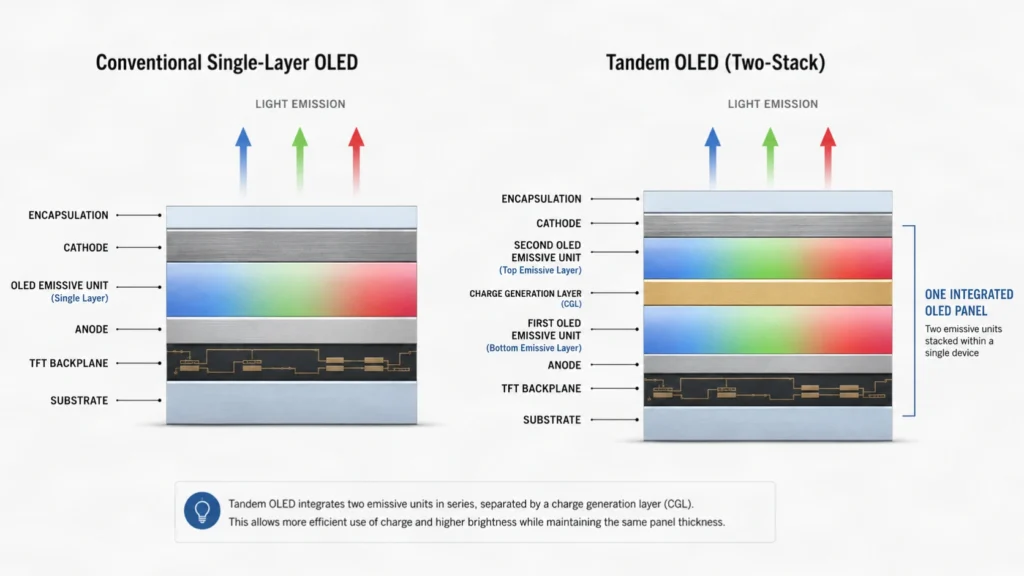
A conventional OLED panel has one stack of organic material between an anode and a cathode. Push current through it and it emits light. Everything you like about OLED comes from that arrangement, because each pixel makes its own light and can switch off completely.
Everything you don’t like comes from it too. One stack does all the work.
Tandem OLED adds a second complete emissive stack directly above the first, separated by a charge generation layer. Both stacks are deposited in the same manufacturing run inside the same vacuum chamber. This is not two panels glued together, and the distinction matters for how it behaves.
The Charge Generation Layer
The CGL is the part that makes the whole thing work, and it’s the part nobody markets.
It sits between the two emissive stacks and generates electrons and holes internally, feeding the second stack without requiring a proportional increase in external voltage. Without it you’d have two OLEDs wired in series, which would be thicker, hotter, and would need roughly double the driving voltage.
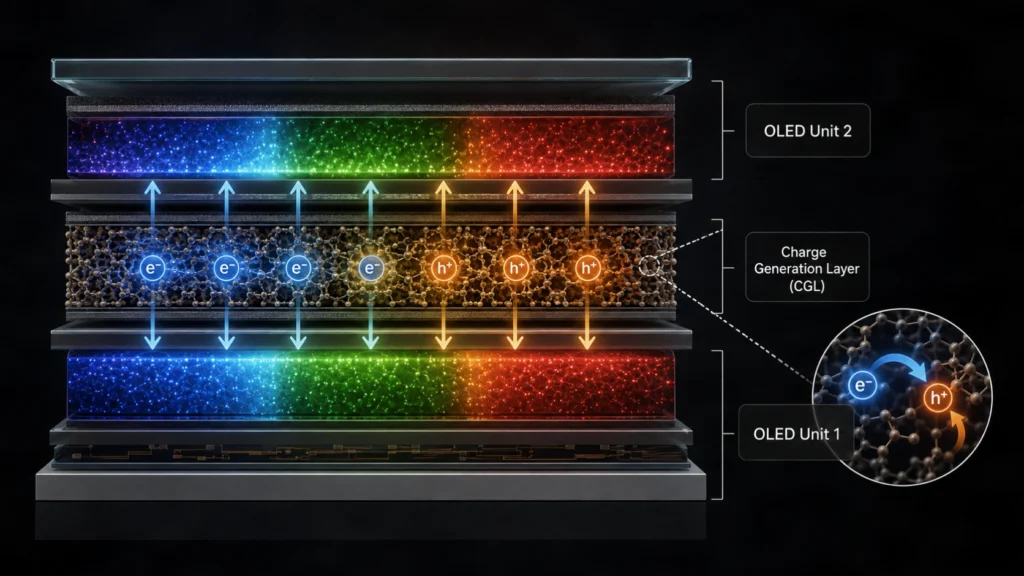
When a spec sheet says “dual-layer OLED” with no mention of a charge generation layer, it’s usually marketing language for a standard panel. The CGL is what separates a genuine tandem stack from a naming exercise.
Why Splitting the Load Extends Lifespan
This is the part worth understanding properly, because it explains every other benefit.
LEDs don’t scale linearly. Getting twice the brightness out of an emissive layer costs considerably more than twice the power, because you’re climbing an efficiency curve that steepens as you push. More power means more heat, and heat is what degrades organic material.
That’s the actual reason single-layer OLED panels have historically run dim. Not that they physically couldn’t go brighter, but that running them hard enough to compete with LCD would have burned through their lifespan in months.
Split the same total current across two stacks and each one operates at roughly half the current density. You drop back down the efficiency curve, where small reductions in power buy disproportionate reductions in heat. Less heat, less degradation, longer life. The brightness ceiling rises as a side effect.
Everything tandem OLED is good at traces back to that one mechanism.
Tandem WOLED vs Primary RGB Tandem
Two architectures share the name, and they behave differently.
Tandem WOLED stacks white-emitting layers and uses colour filters to produce red, green, and blue. It’s LG Display’s approach for TVs, and at CES 2026 the company formally split its branding: Tandem WOLED for televisions, Tandem OLED for IT panels including tablets and laptops.
Primary RGB Tandem stacks emissive layers that produce red, green, and blue directly, with no colour filter blocking output. Because filters absorb light, removing them improves both efficiency and colour purity. LG Display’s fourth-generation implementation, unveiled in 2025, uses a four-stack structure: two blue emission layers plus independently controlled red and green layers.
The practical difference for a tablet buyer is small right now, because tablets that use tandem OLED use the RGB approach. It matters more if you’re cross-shopping a TV.
| Tandem WOLED | Primary RGB Tandem | |
|---|---|---|
| Emissive layers | White, stacked | Red, green, blue, stacked |
| Colour filters | Required | Not required |
| Primary use | TVs | Tablets, laptops, monitors |
| Efficiency | Lower (filter losses) | Higher |
| Colour purity | Good | Better |
| LG branding since CES 2026 | Tandem WOLED | Tandem OLED |
What This Actually Means on a Tablet
Three numbers get quoted. Only two of them will change how you use the device.
Brightness: Watch the Full-Screen Figure
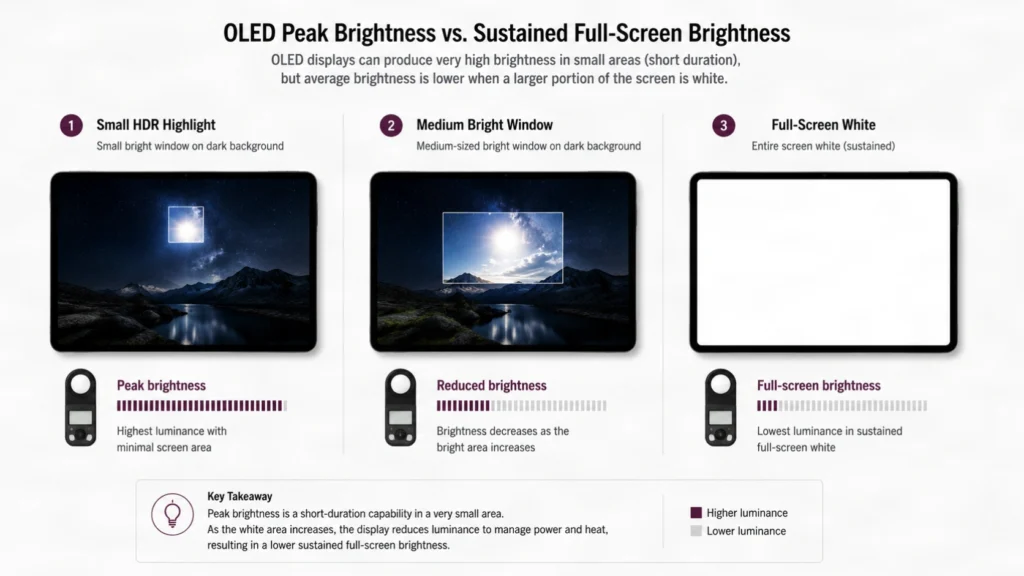
Peak brightness is the number in the advert, and it’s measured on a small window of the screen. A panel can hit 1,600 nits on a 10% window and collapse to a fraction of that when you open a white document.
Full-screen sustained brightness is the number that decides whether you can work outside.
Single-layer OLED tablets typically sustain 200–300 nits full-screen. The iPad Pro’s tandem panel sustains 1,000 nits full-screen and peaks at 1,600 for HDR highlights. That gap is the entire practical argument for the technology.
I’ve written on a balcony in direct afternoon sun with an M5 iPad Pro and read the screen without shading it. I’ve tried the same thing on a single-layer OLED tablet and given up.
When comparing tablets, find the sustained full-screen number, not the peak. If a manufacturer only publishes peak brightness, that usually tells you something about the full-screen figure.
Lifespan: Better, Not Solved
LG Display claims double the lifespan of a conventional single-layer OLED at equivalent brightness. Not four times. That figure circulates widely and doesn’t match what LG actually publishes.
Doubling is still significant. But tandem OLED contains the same organic materials that degrade under current, and burn-in remains possible with genuinely static content over long periods. A permanently visible dock, a video editing timeline that never moves, a status bar at fixed brightness; those are still the risk cases.
Tandem OLED reduces burn-in risk substantially. It doesn’t remove the reasons to use dark mode, auto-hiding docks, and screen timeouts on a device you plan to keep for five years.
Efficiency: Real, and It Shows Up in Battery Life
Lower current density is more efficient current density. LG Display claims up to 40% lower power consumption at matched brightness, and at SID Display Week 2026 announced a third-generation panel drawing 18% less power again, with a 16-inch version extending laptop battery life by up to 2.3 hours.
For a tablet, the efficiency mostly gets spent on brightness rather than banked as runtime. You don’t get dramatically longer battery life; you get a much brighter screen for the same battery life. Whether that’s the right trade depends entirely on where you use the thing.
Which Tablets Actually Have Tandem OLED
“OLED tablet” has become a marketing category, and the overwhelming majority of devices in it use single-layer panels. As of August 2026, only two major tablet product lines currently use Tandem OLED:
| Tablet | Panel | Availability |
|---|---|---|
| Apple iPad Pro 11″ and 13″ (M4 2024, M5 2025) | Ultra Retina XDR, Primary RGB Tandem | Worldwide |
| Huawei MatePad Pro 12.2 (2024) | Tandem-stack AMOLED, 2,800×1,840, 144Hz | China |
That’s the list.
The devices most often assumed to have it don’t. The Galaxy Tab S11 Ultra uses Dynamic AMOLED 2X; an excellent single-layer panel that hits 1,600 nits peak, but a single stack. The Surface Pro 11‘s optional OLED is single-layer. The Lenovo Tab P12 Pro‘s AMOLED is single-layer.
None of that makes those bad screens. The Tab S11 Ultra’s panel is the best 14.6-inch display in any tablet, and I’ve said so in my best large tablets guide. But if you’re paying a premium specifically for tandem OLED, you’re currently choosing between an iPad Pro and an import.
After hands-on testing, the Apple iPad Pro 13-inch (M5) is my top pick for its tandem OLED display and fluid performance. I measured it with calipers, and it’s still surreal that a tablet with an M5 chip and tandem OLED is thinner than my phone. At around 1.28 pounds (579g) for the Wi-Fi model, it’s light enough to hold in one hand while sketching, yet the 13-inch canvas never feels cramped. The build quality is flawless, with tight tolerances and a satisfying heft that signals durability, though the squared-off edges can dig into your palm over time.
That thinness is worth pausing on. A tandem stack adds roughly 0.1–0.2mm over a single layer, and Apple absorbed that while making the 13-inch model 5.1mm thick. LG Display’s laptop tandem panels are around 40% thinner and 28% lighter than the single-layer OLED screens they replaced, which is how the maths works out in Apple’s favour rather than against it.
I put an X-Rite i1Display Pro on the 13-inch M5 and the numbers are the best I’ve recorded on a tablet. Average Delta E came in at 0.36 against a target of under 1.0, which is the threshold below which colour error becomes imperceptible to most observers. One caveat worth stating: the i1Display Pro is a colorimeter rather than a spectrophotometer, and colorimeters without a display-specific OLED correction profile can misread the panel’s narrow-band emitters; independent spectrophotometer testing of the same panel generation returned 0.9 — still exceptional, and the ranking holds either way. DCI-P3 coverage measured 98–100%, effectively the full wide-gamut space.
The brightness result is the one worth knowing about. Apple’s spec sheet lists SDR brightness at 1,000 nits max, but you only reach that with auto-brightness engaged in a bright environment. Drag the slider manually and the panel caps around 600 nits. HDR content is different again: 1,600-plus nits on a 10% window, exactly as specified.
That gap between the spec sheet and the slider is worth understanding before you buy. The 1,000-nit figure is real, but it’s conditional on the ambient light sensor deciding you need it.
How Tandem OLED Got Here
The technology is older than the iPad Pro, and the path explains why it arrived in tablets first.
2019 — Automotive. LG Display commercializes tandem OLED for car dashboards. The requirement wasn’t brightness, it was surviving a decade of temperature swings and sunlight on a dashboard. Durability was the point, and tandem’s low per-layer stress delivered it.
2021–2023 — Laboratory. Multi-stack prototypes appear at industry conferences. The engineering is proven; the manufacturing yields aren’t there for consumer volume.
2024 — The breakthrough. Apple ships the M4 iPad Pro with a Primary RGB Tandem panel branded Ultra Retina XDR: 1,000 nits full-screen, 1,600 peak. It’s the first mass-market device with the technology, and it lands in a tablet rather than a phone or TV because a 13-inch panel is large enough to justify the cost and small enough to yield acceptably. In June, LG Display begins mass production of 13-inch tandem panels for laptops. The Dell XPS 13 becomes the first laptop to ship one, at 2,880×1,800.
2025 — Expansion and branding. LG unveils its fourth-generation Primary RGB Tandem with a four-stack structure. Lenovo’s Yoga Pro 9i, which had shipped mini-LED for two years, switches to a tandem OLED panel hitting 1,600 nits — one device tracking the technology’s evolution in real time.
2026 — Mainstream. LG splits its branding at CES into Tandem WOLED and Tandem OLED. At SID Display Week, third-generation panels post 18% lower power draw and more than double the previous generation’s lifespan. In February, Samsung Display announces a five-layer tandem QD-OLED claiming 1.3× luminous efficiency. In July, ASUS ships the first tandem RGB gaming monitors, the ROG Swift PG27UCWM and PG32UCWM, at 1,000 nits with 4K at 240Hz.
Omdia’s figures put the shape of it plainly: tandem penetration of the OLED tablet and notebook panel market went from near zero to over 30% in 2024, and is forecast at 36% for 2026.
Tandem OLED vs the Alternatives
| Tandem OLED | Single-layer OLED | QD-OLED | Mini-LED | |
|---|---|---|---|---|
| Black level | Perfect (per-pixel off) | Perfect | Perfect | Good, with blooming |
| Full-screen brightness | 1,000 nits (iPad Pro) | ~200–300 nits | ~250 nits | 600–1,000 nits |
| Peak HDR | 1,600 nits (tablets) | ~1,000 nits | ~1,000+ nits | 1,000–2,000 nits |
| Burn-in risk | Reduced, not eliminated | Present | Present | None |
| Power at matched brightness | Lowest | Higher | Higher | Highest |
| Panel thickness | Slightly more than single OLED | Thinnest | Thin | Thickest (backlight array) |
| In tablets | iPad Pro, MatePad Pro 12.2 | Galaxy Tab S11 Ultra, Surface Pro 11, Tab P12 Pro | None currently | Older iPad Pro 12.9 (M1/M2) |
Against Mini-LED
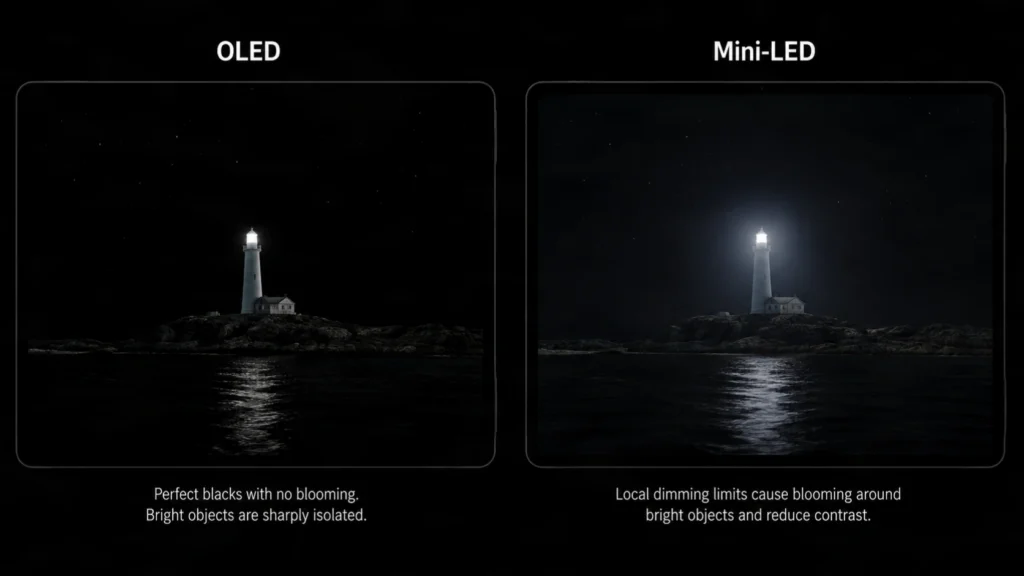
Mini-LED still wins on sustained peak brightness in the largest panels, and it cannot burn in. What it cannot do is switch off an individual pixel, so bright objects on dark backgrounds bloom — a white subtitle on a night scene sits in a faint halo.
If you owned a 12.9-inch iPad Pro with mini-LED and moved to the tandem OLED model, blooming is the difference you noticed first.
Against Single-Layer OLED
Same blacks, same per-pixel control, roughly three times the brightness, double the rated lifespan, less power. There is no scenario where single-layer OLED is technically preferable. It’s cheaper, which is the entire argument for it, and at tablet prices that argument still wins most of the time.
Against QD-OLED
Largely academic for tablet buyers, since no tablet ships QD-OLED. It’s a monitor and TV technology where Samsung’s quantum-dot layer delivers excellent colour volume at high brightness, and where the two architectures are genuinely competitive.
Four Things People Get Wrong
“It’s two screens stacked together.” The layers are deposited sequentially in one manufacturing process, with a charge generation layer between them. It’s one panel with internal structure, not a sandwich.
“It eliminates burn-in.” It reduces the mechanism that causes burn-in by roughly half. Static elements over long periods can still cause retention. Mitigation features still matter.
“Two layers means double the power draw.” The opposite. Each layer runs at lower current density, which sits at a more efficient point on the curve, so total draw at matched brightness is lower — LG claims up to 40% lower.
“All tandem panels are equivalent.” Two architectures, stack counts from two to five, and implementations differing by manufacturer. ASUS’s newly shipped four-stack RGB monitors carry a documented grey-banding limitation in very dark scenes, which is the kind of trade-off that doesn’t appear in a marketing bullet.
What’s Coming
Stack counts are rising. LG’s fourth-generation panels use four layers; Samsung Display announced a five-layer tandem QD-OLED structure in February 2026 claiming double the previous generation’s lifespan.
Apple is reportedly evaluating tandem OLED for iPhones around 2028, likely in a simplified form where the second layer carries only blue subpixels. Blue degrades fastest, so reinforcing it specifically is an efficient compromise.
For tablets, the more interesting question is when a second manufacturer ships one. Tandem panels are in laptops from Dell, Lenovo, HP and ASUS, and in gaming monitors — but Android tablet makers have stayed with single-layer AMOLED, where the panels are cheaper and already very good. That’s a pricing decision, not a technical one, and pricing decisions change.
If tandem OLED is your reason to buy, there’s no waiting strategy that helps in the tablet market specifically. The iPad Pro has been the only mainstream option for two years and nothing announced changes that in the next twelve months.
Is It Worth Paying For?
If you work outdoors or in bright rooms: yes. The full-screen brightness gap is the largest practical difference between tandem and single-layer OLED, and it’s the one you’ll notice daily.
If you do colour-critical creative work: yes. Sustained brightness with per-pixel blacks is what makes HDR grading on a tablet trustworthy rather than approximate.
If you mostly read, browse, and watch indoors: probably not. A good single-layer AMOLED gives you identical black levels and colour in a dim room, which is where most tablets actually get used. The Galaxy Tab S11 Ultra’s panel is superb, and you’re not compromising by choosing it.
If you’re keeping the device five years or more: the lifespan advantage is real but hard to weigh against a price difference you pay today. I’d treat it as a bonus rather than a reason.
The honest summary: tandem OLED is genuine engineering rather than a marketing layer, and it fixed the two things that kept OLED out of bright rooms. But in tablets it currently comes bundled with one specific product line at one specific price. You’re not choosing a display technology. You’re choosing an iPad Pro, and the display is one reason among several.
Frequently Asked Questions
What is tandem OLED in simple terms?
Two complete light-emitting layers stacked inside one panel instead of one, connected by a charge generation layer. Each layer works at roughly half the load to produce the same brightness, which means less heat, slower degradation, and a higher brightness ceiling.
Which tablets have tandem OLED?
The Apple iPad Pro 11-inch and 13-inch, in both the M4 (2024) and M5 (2025) generations, and the Huawei MatePad Pro 12.2, which is sold in China. Most tablets advertised as OLED use single-layer panels.
Does the Galaxy Tab S11 Ultra have tandem OLED?
No. It uses Dynamic AMOLED 2X, a single-layer panel. It’s an excellent display that reaches 1,600 nits peak, but the stack architecture is different.
Does tandem OLED prevent burn-in?
It reduces the risk substantially by halving the current density each layer handles, and LG Display rates the panels at double the lifespan of single-layer OLED. It does not eliminate burn-in. Static interface elements over long periods can still cause retention.
Is tandem OLED brighter than mini-LED?
In full-screen sustained brightness they’re now comparable. Mini-LED can still reach higher peaks on large panels. Tandem OLED wins decisively on contrast, because mini-LED backlights bloom around bright objects on dark backgrounds.
Does tandem OLED use more power?
No — less. At the same brightness it draws up to 40% less than single-layer OLED, according to LG Display, because each layer operates at a more efficient point on the power curve.
Is tandem OLED thicker?
The stack adds roughly 0.1–0.2mm. In practice it’s not a constraint: the 13-inch M5 iPad Pro is 5.1mm thick with a tandem panel inside it.
Trust & Sourcing
- I research display technology using manufacturer documentation, industry sources, and hands-on testing, then use those sources to verify technical specifications and claims rather than relying on recycled summaries.
- For this article, the underlying Tandem OLED technology is cross-checked against LG Display’s Tandem OLED information, while product specifications are checked against the manufacturer’s own documentation, including Apple’s official iPad Pro specifications.
- Where I provide brightness, color, or other display measurements, those are my own results from hardware I tested, not manufacturer figures. I keep those measurements separate from published specifications so you can distinguish what the manufacturer says from what I actually observed.
- The technical explanations and conclusions are my own analysis of how Tandem OLED works and what its characteristics mean in real-world tablet use.
- Because display technology and tablet lineups change, product availability and specifications are checked against current manufacturer information when this article is updated.

Dan has personally tested more than 50 large tablets since 2021, living with each one as his only computer for at least two weeks before writing a word.
Dan Mercer
Founder & Lead Reviewer, Large-Tablet.com
Experience
I review large tablets — 12 inches and up — and I try to answer one honest question: is this really worth your $1,000-plus? Since 2021 I’ve tested more than 50 tablets from Apple, Samsung, Lenovo, Microsoft, OnePlus, Xiaomi and others. Between 2021 and 2023 I worked as an independent mobile device consultant, repairing and configuring Android and Apple hardware for hundreds of people.