How Large-Tablet.com Tests Tablets
Most tablet reviews are written after a launch-event demo and a weekend of use. That’s enough time to admire an OLED panel. It is nowhere near enough time to discover that the battery collapses under real creative work. It’s not enough to know that the keyboard case develops a wobble. It’s not possible in such a small timeframe to judge that a software update quietly changes the entire value proposition.
So here’s the exact regimen every device on this site goes through. Nothing gets a verdict until it has survived all of it.
The two-week rule
Every tablet becomes my only computer for a minimum of 14 days. No laptop fallback. If the tablet can’t do something, I live with the friction, document it, and it goes in the review.
Why two weeks? Because the failures that matter are slow. Battery honeymoon fades after the first few charge cycles. Keyboard fatigue shows up in week two. Software quirks appear once the novelty wears off and you’re just trying to work. In my experience across 50+ devices, almost every dealbreaker surfaces between day eight and day twelve.
Where the devices come from?
Each review states, in its opening section, exactly how the unit was sourced:
- Purchased at retail — bought with my own money, kept or resold like any owner.
- Manufacturer review loaner — provided for testing and returned afterward.
- Borrowed — sourced from a private owner for comparison testing.
Manufacturers never preview reviews before publication, never influence scores, and don’t get to “fact-check” opinions. The running log below shows every device tested and its source.
Devices tested on the bench
| Device | How I got it | Tested |
|---|---|---|
| Apple iPad Pro 13″ (M5) | Purchased at retail | Oct – Nov 2025 [Retest: July 2026] |
| Samsung Galaxy Tab S11 Ultra | Purchased at retail | Nov – Dec 2025 [Retest: July 2026] |
| OnePlus Pad 3 | Purchased at retail, full price | Jan 2026 [Retest: July 2026] |
| Microsoft Surface Pro 11 | Purchased at retail | Sept – Oct 2025 [Retest: July 2026] |
| Lenovo Tab P12 Pro | Purchased refurbished | Feb – Mar 2026 [Retest: July 2026] |
| Meswao B3 Pro 15.6″ | Purchased at retail | Apr 2026 [Retest: July 2026] |
| KTC 25″ MegaPad | Borrowed from a friend | May 2026 [Retest: July 2026] |
Benchmarks: identical conditions, every time
Raw performance is measured with Geekbench 6 and 3DMark Wild Life Extreme, always under the same conditions:
- 50% screen brightness
- Wi-Fi 6E network
- 22°C ambient room temperature
- Fresh boot, no background sync
Identical conditions are the whole point: it means a score in one review is directly comparable to a score in any other review on this site. Alongside synthetic benchmarks, I run timed app launches and multitasking stress tests, because a great Geekbench score with stuttery split-screen is a spec-sheet victory and a real-world loss.
I publish what I measure (including runs that contradict manufacturer claims).
The three-scenario protocol
Every device runs three real-life gauntlets:
1. The café test
Keyboard case attached, a dozen Chrome tabs, Slack, and a live Google Doc, entirely on battery. This is where marketing promises of “buttery-smooth” multitasking go to die. Or occasionally, to be vindicated.
2. The desk test
External 4K monitor, external keyboard, and a full evaluation of the multitasking layer. I test the Stage Manager, DeX, or whatever the platform offers. Can it hold a desktop-like workflow for a full afternoon, or does window management fall apart at tab fifteen? That’s what I’m trying to find out.
3. The couch-and-flight test
HDR streaming, reading, one-handed comfort, and weight over long sessions. Plus, a real flight whenever schedules allow. A 14-inch tablet that’s glorious on a desk can be miserable at 35,000 feet, and you deserve to know which is which.
Battery: real numbers, labeled honestly
Manufacturer battery claims are measured under gentle conditions, usually a video loop at fixed brightness. I report those claims alongside my own figures, measured across three standardized scenarios.
Every battery test runs at a calibrated 200 nits screen brightness and 22°C room temperature:
- Video playback — a 1080p HDR film on loop, Wi-Fi off, volume at 50%.
- Web browsing — a fixed set of 20 modern, ad-heavy pages on Wi-Fi, refreshing every 30 seconds.
- Mixed use — a simulated workday: 45 minutes of note-taking, 30 minutes of video calls, an hour of streaming, and the rest split between document editing and light photo work, all on Wi-Fi.
Note that benchmarks run at 50% brightness while battery tests run at a fixed 200 nits. Different tests, different controls: the point of each is that it’s identical across every device on this site.
Example of what that looks like in practice: Apple rates the M5 iPad Pro at up to 10 hours of web and video. Under sustained creative work in my testing (rendering, gaming, streaming), it delivered roughly 6 hours. You get both numbers, clearly labeled.
Cross-verification before publishing
Before any review goes live, I check my findings against aggregated owner feedback on Reddit and XDA, retailer reviews, and other independent outlets. Where my results diverge from the consensus (and they sometimes do), the review says so explicitly and explains the likely reason: different test conditions, different unit, different software build.
I’d rather flag a discrepancy myself than have you find it.
Photography
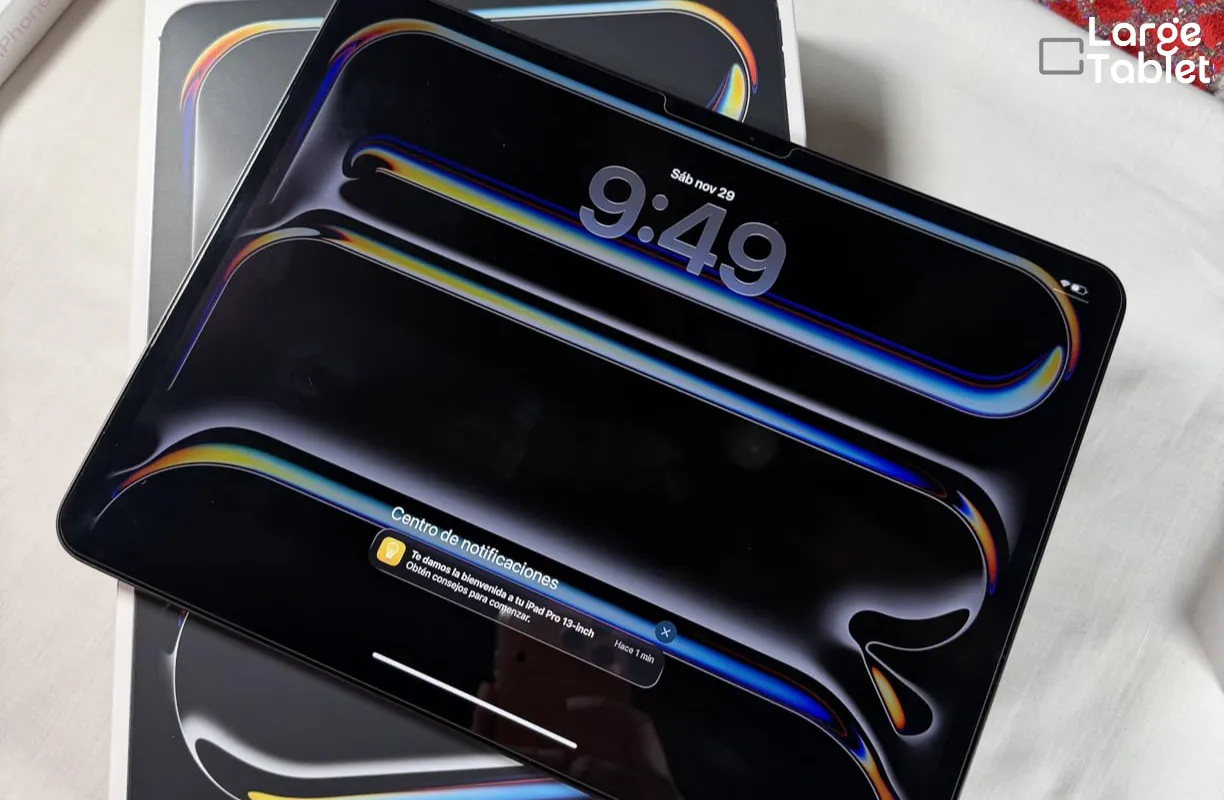
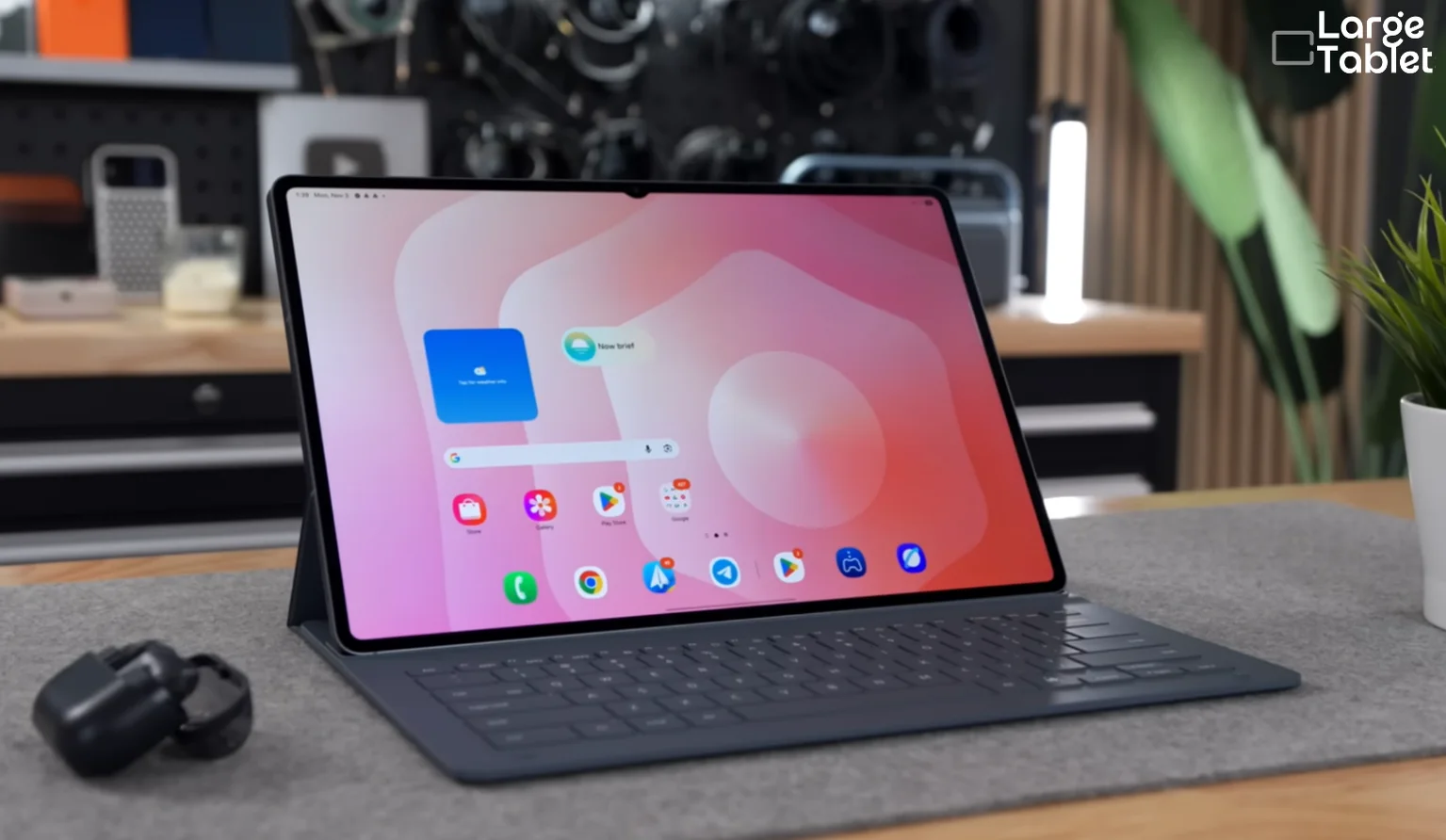
Every product photo on Large-Tablet.com is shot by me, of the actual unit tested, in my actual workspace. No manufacturer renders as review images. No stock photography. No AI-generated imagery, ever. If you see a scuff on a keyboard case in a photo, it’s because the case earned it during testing.
The one exception is a device I haven’t received yet. Unreleased products in a “coming soon” section carry no photo at all, because I can’t photograph something I don’t have.

Scores can change, and do
Tablets are software products, and software moves. When an update materially changes a verdict, I retest and update the review, with a visible “Last updated” date and a changelog note explaining what changed.
Questions about the methodology?
Email dan@large-tablet.com. If a reader suggestion improves the test regimen, it gets adopted and credited.